Pirates of the Mediterranean
Part I: The Ancient Aegean
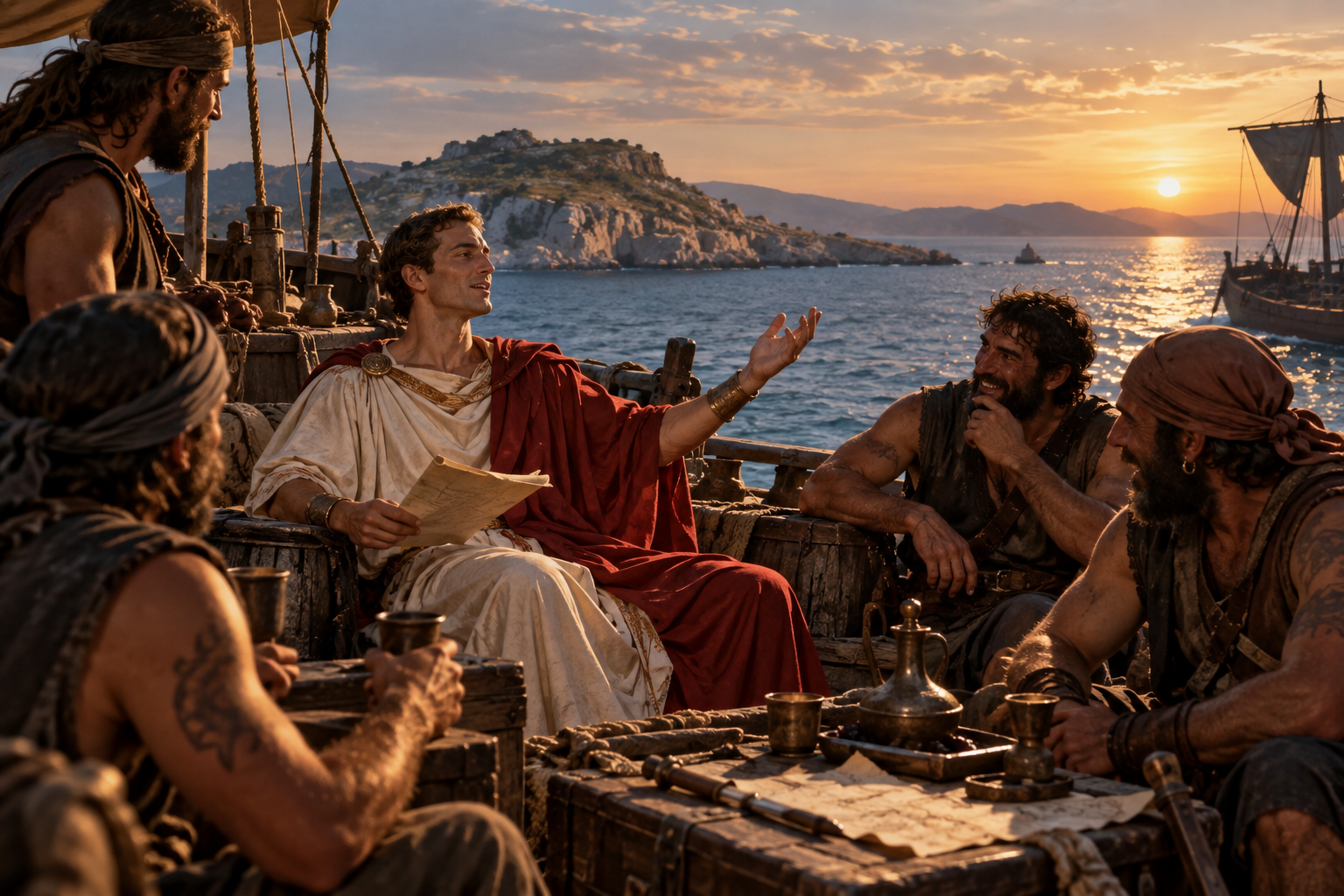
Twenty talents for a Roman
Around 75 BC, a young Roman aristocrat sailing to Rhodes to study rhetoric was seized by pirates near Pharmacusa, a small island off the Carian coast. Today it is called Farmakonisi, a speck of rock between Didim and Leros. The prisoner was Gaius Julius Caesar, then about twenty-five.
According to Plutarch, the pirates asked for twenty talents. Caesar laughed at them for not knowing whom they had caught and told them to ask for fifty. He then sent his companions to the coastal cities to raise the money and stayed behind with a doctor and two servants.
For roughly 38 days he lived among his captors as if they were his bodyguards. He joined their games, wrote poems and speeches, read them aloud, and called his audience illiterate barbarians when they failed to applaud. He also promised, half in jest, to crucify them all.
Once the ransom arrived, Caesar went straight to Miletus, manned a few ships and sailed back to the island. He caught most of the pirates still anchored there, took their money and handed them to prison at Pergamon. When the provincial governor hesitated, Caesar had them crucified himself. Suetonius adds a grim detail: as a mercy, he had their throats cut first.
The story is usually told as a portrait of Caesar. It is just as revealing as a portrait of the Aegean. In the first century BC, a Roman of senatorial family could be snatched a few hours' sail from Miletus. That was not an accident. It was the result of more than a thousand years of history in which the sea between Anatolia and Greece had been one of the best places in the world to be a pirate.
The Lukka and the Sea Peoples
The earliest written complaint about Aegean raiders is more than 3,300 years old. In one of the Amarna letters of the 14th century BC (EA 38), the king of Alashiya, usually identified with Cyprus, answers an Egyptian accusation. His own land, he protests, is raided every year by men of Lukka, who seize villages one by one.
The Lukka lands appear in Hittite texts on the southwestern coast of Anatolia, roughly the region later called Lycia, between Fethiye and Antalya. It is the same coast of deep bays and hidden coves that Blue Cruise boats sail today.
The Lukka resurface in Egyptian records at the end of the Bronze Age. Pharaoh Merneptah lists them among the northern peoples who joined a Libyan attack around 1208 BC. A generation later, the reliefs of Ramesses III at Medinet Habu, conventionally dated to about 1177 BC, show a great sea battle against a coalition modern historians call the Sea Peoples.
Whether these groups were pirates, migrants or displaced armies is still debated. Most were probably all three at once. What matters for our story is the pattern: whenever central power on the eastern Mediterranean weakened, the islands and coasts of the Aegean produced men who made their living from the sea by taking.
"Are you pirates?" — a polite question
In the Odyssey, when Telemachus lands at Pylos, old King Nestor feeds him first and only then asks who he is. Are the strangers travelling on business, he wonders, or roaming the sea at random like raiders who risk their lives to bring harm to others? The Cyclops asks Odysseus the very same thing.
Nobody takes offence. Thucydides, writing in the 5th century BC, explains why. In early times, he says, Greeks and non-Greeks living on the coasts and islands turned to piracy once they learned to cross the sea. Led by powerful men, they fell on unwalled towns and lived mostly from plunder. The activity carried no shame and even some glory, which is why the old poets had people ask newcomers whether they were pirates.
Odysseus himself proves the point. Leaving Troy, his first act is to sack Ismaros, a town of the Cicones on the Thracian coast, killing the men and sharing out the women and goods. Homer tells it without apology.
The line between trader, raider and warlord stayed thin for centuries. Herodotus describes Polycrates, the 6th-century BC tyrant of Samos, as running a fleet of a hundred ships that plundered friend and enemy alike. Just a short sail from Kuşadası, one of the most brilliant courts of archaic Greece was, in modern terms, a pirate state.
A sea built for ambush
Ancient piracy was not random. It followed the shape of the sea, and the Aegean has almost the perfect shape.
Coastal sailing. Ancient ships rarely crossed open water if they could avoid it. They hugged the coast and moved from island to island, usually beaching or anchoring at night. Every trader's route was predictable, and every night stop was a chance for an attack.
Chokepoints. Straits such as the channel between Samos and Mycale, or the waters around Chios and the Karaburun peninsula, force shipping into narrow lanes. A lookout on a headland could see a sail hours before it arrived.
Hiding places. Thousands of coves, bays and islets gave light oared ships places to wait, hide and escape into water too shallow for pursuers.
The sailing season. Most voyages happened between spring and autumn. In high summer the northerly winds the Turks call meltem made sailing directions even more predictable.
Poor land. Rugged coasts with little farmland, such as "Rough" Cilicia along the Taurus mountains, pushed people toward the sea. The same mountains supplied timber for ships.
Move any of these features and piracy gets harder. Put them all together and it becomes almost a rational career choice, which is exactly how the ancients themselves saw it.
How Rome fed the pirates it later fought
For much of the 3rd and early 2nd centuries BC, the Aegean had a policeman: Rhodes. The island republic lived from trade and harbour dues, so it kept a strong navy and fought pirates, including a war against Cretan raiders around 205–200 BC.
Then Rome changed the rules. After the Third Macedonian War, the Senate punished Rhodes for its lukewarm loyalty by declaring Delos a free port in 166 BC. Polybius reports that Rhodian harbour revenue collapsed from about one million drachmas a year to about 150,000. With less money, Rhodes had fewer ships, and the Aegean lost its patrol.
Delos, meanwhile, became the great slave market of the Mediterranean. Strabo writes that the island could take in and ship out tens of thousands of slaves in a single day. After Rome destroyed Carthage and Corinth in 146 BC, demand from Italian estates grew. Buyers at Delos did not ask where a captive came from.
This was the business model of the Cilician pirates. Strabo traces their rise to Diodotus Tryphon, a would-be Seleucid king who used the fortress of Korakesion, today's Alanya, as his base around 140 BC. Captives taken anywhere in the eastern Mediterranean could be sold at Delos at a profit. Rome, the biggest customer, had little reason to intervene.
By the early 1st century BC the pirates had grown into a sea power with hundreds of ships, allied at times with Rome's enemy Mithridates VI of Pontus. Caesar's kidnapping off Farmakonisi was one small episode in this much larger economy.
Three months that cleared the sea
By 68 BC the problem had reached Italy itself. Pirates attacked Ostia, Rome's own port. According to Plutarch they kidnapped two praetors, Sextilius and Bellinus, together with their attendants. Grain ships stopped arriving, and prices in Rome rose.
In 67 BC the tribune Aulus Gabinius passed a law giving Pompey an extraordinary command: authority over the whole Mediterranean and the coast up to about 80 km inland, for three years. Plutarch puts the resources at 500 ships, 120,000 infantry and 5,000 cavalry. Many senators feared it made one man master of the Roman world.
Pompey's plan was methodical. He divided the Mediterranean into thirteen zones, each under a legate, so the pirates could not simply move from one area to the next. Plutarch says the western sea was cleared in forty days. Pompey then turned east toward the Cilician strongholds.
The last great resistance came at Korakesion, the rock on which Alanya's citadel now stands. After a battle there, the remaining pirates surrendered. Plutarch says the whole war took less than three months; ancient totals of ships and prisoners vary between authors and should be read as approximate.
Pompey's most interesting decision came afterward. Instead of executing the thousands who surrendered, he resettled many of them as farmers. Plutarch names Mallus, Adana and Epiphaneia in Cilicia, and Dyme in Greece. He also repopulated Soli, near today's Mersin, and renamed it Pompeiopolis. The logic was simple: give men land, and they no longer need the sea.
What the pirates left behind
Pompey did not end piracy forever, but he ended it as a system. For most of the following centuries, under Roman control of the whole coastline, the Mediterranean was safer than it had ever been. The lesson was clear: piracy thrives when no single power controls the sea and when a market exists for what pirates take.
The ancient pirates left their mark on the places we know today. Farmakonisi, Alanya's rock, the ruins of Pompeiopolis near Mersin and the lonely coves of Lycia are all stops on the same story. When you anchor in a quiet bay on the Turquoise Coast, you are often choosing exactly the kind of spot a raider would have chosen: sheltered, hidden and with a view of the passing traffic.
When Rome's grip loosened, the pattern returned. In Part II, we follow it into the age of galleys and corsairs: Kemal Reis, the Barbarossa brothers, Turgut Reis and the Knights of Malta, when the Mediterranean was divided into two empires and one side's pirate was the other side's hero.
Sources
All ancient references are to standard editions; numbers from ancient authors are their estimates, not audited figures.
Amarna letter EA 38 (king of Alashiya to the Pharaoh), 14th century BC
Homer, Odyssey 3.71–74 (Nestor), 9.39–61 (Ismaros), 9.252–255 (the Cyclops)
Thucydides, History of the Peloponnesian War 1.4–1.5
Herodotus, Histories 3.39 (Polycrates of Samos)
Polybius, Histories 30.31 (Rhodian harbour revenue after Delos became a free port)
Strabo, Geography 14.3.2 and 14.5.2 (Cilician pirates, Diodotus Tryphon, the Delos slave market)
Plutarch, Life of Caesar 1–2; Life of Pompey 24–28
Suetonius, Life of Julius Caesar 4 and 74
Cicero, On the Command of Gnaeus Pompey (Pro Lege Manilia) 31–35
Philip de Souza, Piracy in the Graeco-Roman World (Cambridge University Press, 1999), for modern background
Comments
No comments yet. Be the first.