The $5 Million Yacht Fire That Started With a Bypassed Safety System
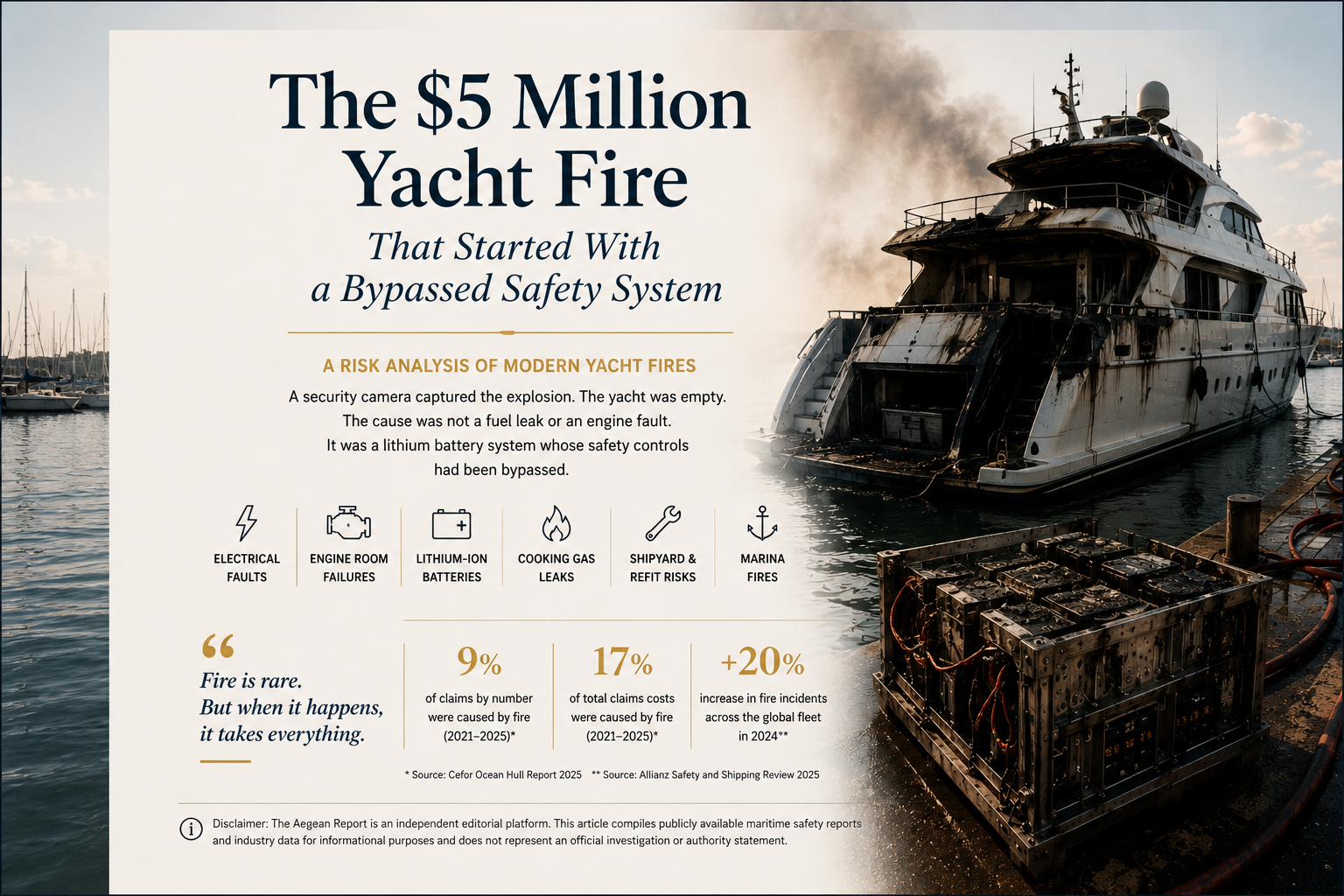
On April 28, 2024, a security camera at a Miami shipyard captured an explosion aboard Flagship, an 82-foot yacht valued at $5 million.
The vessel was uncrewed and docked inside an enclosed bay of the shipyard when the fire began. Shoreside firefighters moved it to a nearby sea wall and extinguished the flames. The yacht eventually sank. It was declared a total loss.
The cause was not a fuel leak or a conventional engine fault.
According to the U.S. National Transportation Safety Board, the yacht's lithium-ion battery management systems were inoperable. Instead of resolving the underlying issue, personnel developed a procedure to charge the batteries faster by bypassing the safety systems and manually charging the battery banks with portable chargers.
This compromised the safe monitoring of the vessel's batteries.
Investigators concluded that the probable cause of the fire was thermal runaway and an explosion in the yacht's 24-volt lithium-ion battery bank. [1]
A complex vessel was destroyed not by one dramatic mistake, but by a chain of unresolved technical problems and a workaround that gradually became normal.
That is what makes the case worth paying attention to.
Fire Is Not the Most Common Marine Incident. But It Is One of the Most Destructive.
A fire aboard a yacht is relatively uncommon. The financial consequences can still be extreme.
In the Nordic Association of Marine Insurers' NoMIS ocean hull portfolio, fires represented 9 percent of claims by number but 17 percent of total claims costs between 2021 and 2025. In 2025 alone, seven of the thirteen reported losses exceeding $10 million were caused by fire. Four of those were the costliest claims of the year. [3]
These figures cover ocean-going commercial vessels rather than yachts alone. They should not be read as a yacht-specific loss ratio. But the underlying severity pattern matters for every vessel owner: once a fire takes hold in an enclosed marine environment, the distance between repairable damage and total loss can disappear quickly.
The trend is also moving in the wrong direction. Allianz Commercial recorded 250 fire incidents across the global shipping fleet in 2024, a 20 percent increase from the previous year and the highest total in a decade. [4]
The practical lesson is not that every yacht is likely to burn.
It is that fire prevention deserves far more attention than its frequency might suggest.
Six Fire Risks Every Yacht Owner Should Track
1. Electrical faults: the slow-building risk
Electrical problems rarely begin as dramatic failures. They develop quietly through ageing cables, corroded connections, overloaded circuits, loose terminals and improvised repairs.
A BoatUS analysis of recreational-boat insurance claims found that DC electrical systems — including batteries, lights and wiring — caused more than a third of onboard fires. AC shore-power systems contributed another 9 percent. [7]
Shore power deserves particular attention. Salt, moisture, vibration and corrosion can damage the connection between the marina pedestal, the cable and the boat's inlet. A connection may appear functional while generating enough resistance and heat to ignite nearby material.
The solution is not complicated. Inspect electrical connections regularly, replace damaged components promptly and treat heat, discoloration and corrosion as warning signs rather than cosmetic issues.
A yacht's electrical system does not need to fail suddenly to become dangerous. It only needs to deteriorate quietly for long enough.
2. Engine rooms: where small failures escalate fast
Engine rooms contain everything a fire needs: fuel, oil, heat and ventilation.
Gard identifies a recurring pattern in its hull and machinery claims: an oil-system failure deposits oil onto a high-temperature surface and ignition follows. Exhaust manifolds, turbochargers, boilers and exposed piping can exceed 500°C — well above the temperature required to ignite oil. [5]
The 2023 fire aboard the passenger vessel Ocean Navigator shows how quickly a maintenance issue can become a major casualty.
The vessel's auxiliary diesel generator engine suffered catastrophic mechanical damage while the ship was docked in Portland, Maine. Hot atomized lubricating oil escaped from the ruptured engine block and ignited. One crewmember was seriously injured, and the vessel sustained an estimated $2.4 million in damage.
The NTSB found that debris in the engine's lubricating-oil system caused the failure. Investigators noted that the oil had been used for more than 5,000 operating hours, exceeding the manufacturer's recommended interval by five times. The filter elements had been used for 3,329 hours, more than three times the recommended interval. [2]
Maintenance schedules are not administrative formalities.
They are part of the vessel's fire-protection system.
3. Lithium-ion batteries: the new risk profile
Lithium-ion batteries are becoming increasingly common aboard modern yachts. They offer high energy density, reduced generator use and greater flexibility for electrical systems.
The same energy density creates a different category of risk.
When a lithium-ion cell fails, it can enter thermal runaway: a self-sustaining chemical reaction in which the battery generates heat faster than it can dissipate it. The heat produced by a lithium-ion cell in thermal runaway can exceed 1,100°F, or approximately 593°C. This can ignite adjacent cells and spread rapidly through a battery bank. [1]
The U.S. Coast Guard warns that once thermal runaway propagates across battery modules, suppressing the fire becomes extremely difficult. The priority shifts toward early detection, fire containment and heat absorption through water-based suppression systems. [6]
Battery management systems are therefore not optional layers of software. They are safety-critical components designed to reduce the risks associated with overcharging, undercharging and excessive cycling.
The lesson from Flagship is not that lithium-ion batteries should be avoided.
It is that advanced systems must be managed with the discipline they require.
4. LPG systems: the invisible accumulation
Liquefied petroleum gas is heavier than air.
When it leaks, it does not necessarily disperse. It can travel downward and collect in low areas of a vessel, including the bilge, until it forms an explosive mixture with air.
The risk is especially dangerous because the leak may remain unnoticed until an ignition source appears.
Guidance published by the UK's Maritime and Coastguard Agency provides a useful practical benchmark: gas-detector heads should be installed in the lower parts of compartments where gas may accumulate, and detection systems should preferably activate automatically at concentrations no greater than 0.5 percent in air. [8]
Any yacht with an LPG cooker or heater should have functioning detectors, properly ventilated cylinder storage, accessible shut-off systems and regular leak testing.
Improvised repairs have no place in an LPG installation.
5. Refit periods: when temporary solutions become permanent risks
A yacht undergoing construction or refit faces a different set of hazards.
Multiple contractors may be working on board at the same time. Electrical systems may be partially disconnected. Fuel systems may be opened. Welding, grinding and other hot work may take place close to combustible materials. Temporary chargers, extension cables and workarounds may remain in use longer than intended.
The Flagship case is particularly striking because the yacht was destroyed while docked at a shipyard.
Brookes Bell recommends that shipyards, yacht managers and project managers conduct a risk analysis before major work begins. That assessment should cover hot-work procedures, electrical cabling, subcontractor controls, ventilation and the spacing between vessels. [9]
Owners should request written documentation of any temporary electrical arrangements and confirm that those arrangements are removed or formally approved once the work is complete.
A temporary workaround is no longer temporary once everyone becomes accustomed to it.
6. Marina fires: your neighbour's problem can become yours
A vessel does not need to develop its own fault to be destroyed by fire.
Boats are often moored close together, surrounded by combustible materials and connected to shore power. A fire originating aboard one vessel can spread to neighbouring yachts, dockside equipment and marina facilities before crews or emergency responders can contain it.
Brookes Bell documents a striking example: the sailing yacht Danneskjold and the motor yacht Drinkability were both destroyed after a fire spread between vessels at a shipyard in Rhode Island. [9]
Fibreglass burns. Fuel tanks intensify the risk. Tight spacing shortens the response window.
Marina choice is therefore a fire-safety decision. Electrical infrastructure, overnight monitoring, emergency access, vessel spacing and response procedures all matter.
What Does Insurance Actually Cover?
Fire is commonly included within marine insurance coverage, but the wording of the policy matters.
Clyde & Co notes that standard yacht-policy wordings generally provide some form of protection against fire damage. The exact extent of that cover still depends on the policy, the circumstances of the incident and the vessel's status at the time of the loss. Coverage may vary depending on whether the yacht is operational, laid up, undergoing construction or being refitted. [10]
The details matter even more when advanced battery systems, temporary electrical arrangements or major modifications are involved.
Owners with lithium-ion installations should ask their insurer several questions in writing:
Is thermal runaway explicitly covered?
Does the policy require the battery management system to remain fully operational?
Are portable chargers or modified charging procedures permitted?
Would an unapproved electrical modification affect coverage?
Are there inspection or documentation requirements for the battery system?
Who carries the risk while the yacht is under construction or undergoing a major refit?
Insurance should not be treated as a substitute for maintenance.
After a serious incident, surveys, maintenance records, alarm histories, refit documentation and system modifications may all become important.
These are questions to ask before a loss, not after one.
The Bigger Question
Modern yachts are becoming more powerful, more electrified and more complex.
Every new system may improve comfort, efficiency or performance. It also creates another maintenance obligation and another potential point of failure.
The most important lesson from the Flagship fire is not simply that lithium-ion batteries carry risks. It is that technical discipline matters.
A bypassed safety system is not a minor workaround.
A missed maintenance interval is not just a line in a spreadsheet.
A temporary fix is not temporary once it becomes part of the routine.
As yachts store more energy within every square metre of hull, the question is no longer whether the technology is impressive.
It is whether the systems designed to control that energy are being treated with the seriousness they require.
Disclaimer: This article is based on publicly available reports, marine safety investigations, and insurance industry publications. It is intended for informational and editorial purposes only and does not represent an official investigation or regulatory statement.
Sources & Further Reading
[1] National Transportation Safety Board. Fire aboard Yacht Flagship. Marine Investigation Report MIR-25-31. July 28, 2025.
[2] National Transportation Safety Board. Diesel Generator Engine Failure aboard Passenger Vessel Ocean Navigator. Marine Investigation Report MIR-25-13. April 2, 2025.
[3] The Nordic Association of Marine Insurers (Cefor). Ocean Hull Report 2025.
[4] Allianz Commercial. Safety and Shipping Review 2025.
[5] Gard. Engine Room Fires Are Still a Major Concern. February 13, 2025.
[6] United States Coast Guard. Marine Safety Alert 14-25: Lithium-Ion (Li-Ion) Battery System Installations. July 14, 2025.
[7] BoatUS. Analyzing Electrical Fires on Boats. April 2018.
[8] Maritime and Coastguard Agency. MGN 280(M): Small Vessels in Commercial Use for Sport or Pleasure, Workboats and Pilot Boats — Alternative Construction Standards.
[9] Brookes Bell. Superyacht Fires: The Importance of Proactive Risk Mitigation. September 21, 2022.
[10] Clyde & Co. Superyacht Fires and Insurance: Flammable or Fireproof. October 18, 2022.
Comments
No comments yet. Be the first.