The Fisherman of Halicarnassus: How One Man Transformed Bodrum from a Town of Exile
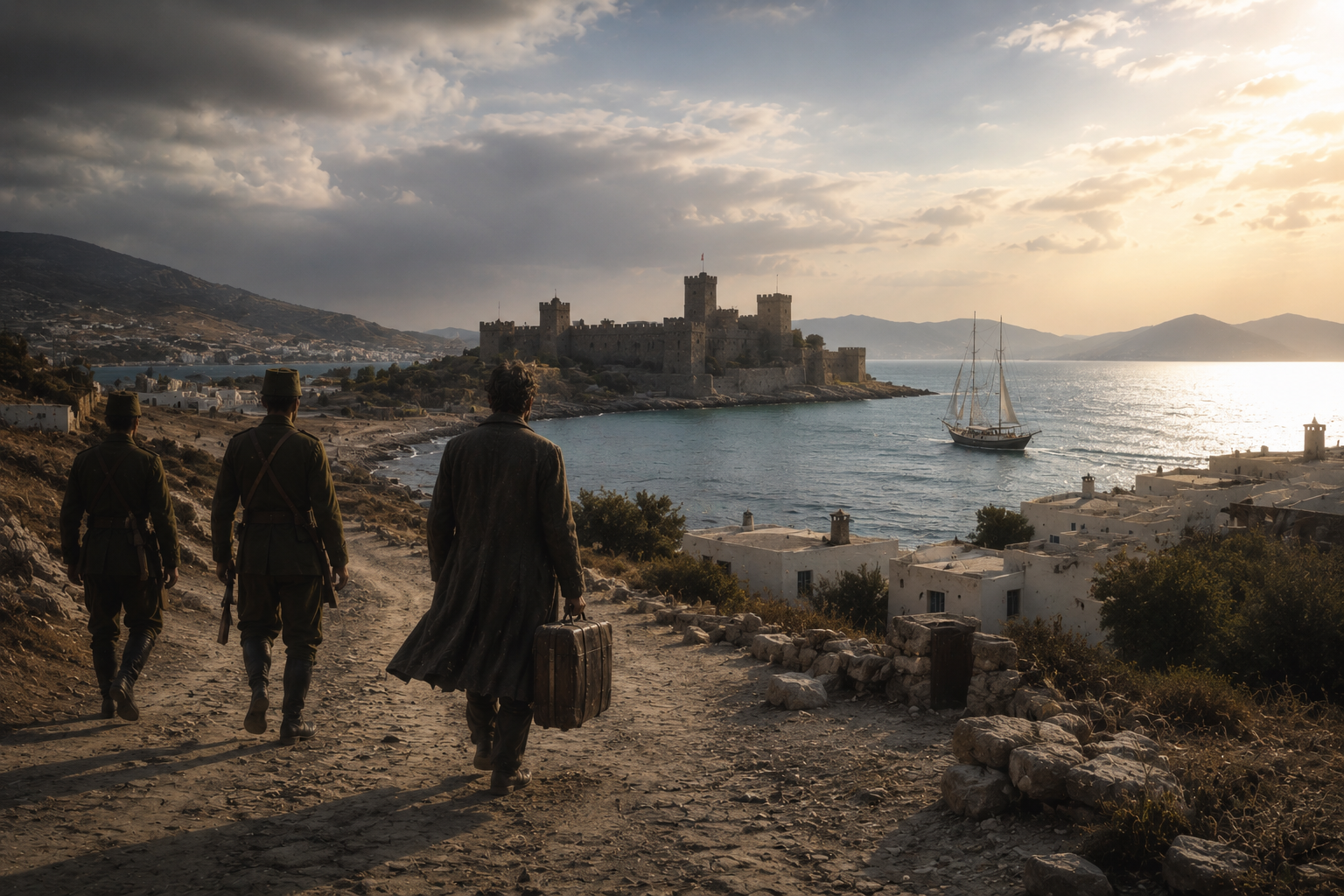
On a day in 1925, a man was being walked to Bodrum — from Istanbul to Ankara, and then onward in a long and exhausting journey, flanked by two gendarmes. He wore an old coat; the few coins in his pocket were nearly gone. He traveled by train, by rickety buses, and often on foot, handed from one police post to the next. Bodrum had a grim reputation in those years — a remote, inaccessible town, known mainly as a place where political prisoners were sent to disappear. The man himself would write years later that when he first heard the name of the fortress town, what came to mind was a dungeon where Sultan Abdülhamid had sent men deemed "dangerous" to rot away.
The man's real name was Musa Cevat Şakir. The days when he would be known by the name history would remember him by had not yet come.
**
The story begins on April 17, 1890, in Crete. His father, Mehmed Şakir Pasha, was a historian and statesman from the prominent Ottoman Şakir Pasha family, serving at the time as High Commissioner in Crete. His uncle, Ahmed Cevad Pasha, had served as Grand Vizier during the reign of Abdülhamid II. Cevat Şakir spent his childhood in Athens, following his father's posting, before the family settled on Büyükada. He completed his primary education there, his secondary schooling at Robert College in Istanbul, and then — at his family's urging — studied history at the University of Oxford. A love of the sea had been in him since childhood, but he wandered through painting, history, and literature before finding his footing; he also spent time studying art in Italy.
In 1914, the family fell into financial difficulty, and Mehmed Şakir Pasha retreated to the Kabaağaçlı estate in Afyon. It was there that a long-simmering tension between father and son reached a point of no return: during a violent argument on the farm, a shot fired from Cevat Şakir's gun killed his father. He was tried for murder and sentenced to fifteen years of hard labor. After serving seven years, he was released on grounds of deteriorating health — he had contracted tuberculosis. In the years that followed, he scraped together a living writing and translating for weekly magazines, drawing cartoons, and designing colorful magazine covers, contributing along the way to the development of cover design in the Turkish press.
The defining moment came on April 13, 1925. Writing under the pen name "Hüseyin Kenan," he published a story in the magazine Resimli Hafta titled "How Those Condemned to Death in Prison Go Knowingly to the Gallows" — a piece about the tragic fate of four military deserters. The Turkey of those days was a country where the Sheikh Said rebellion had just been suppressed and the press operated under severe restrictions. The story brought him before the Istanbul Independence Tribunal on charges of "inciting military insubordination and discouraging military service." The court sentenced him to exile in Bodrum with a ban on leaving — three years in total.
Bodrum's name was bleak, but by a strange twist of fate, Cevat Şakir found himself there. He served the first half of his sentence in Bodrum, the second in Istanbul. When his sentence was fully completed in 1928, he could have stayed in Istanbul; instead, not long afterward, he chose to return to Bodrum of his own accord, and would live there for approximately twenty-five years. He took the pen name "Halikarnas Balıkçısı" — the Fisherman of Halicarnassus, after the ancient name of Bodrum — both to shed the weight of his own name and to free the town, still known then chiefly as a place of exile, from that dark reputation. He worked as a fisherman, a gardener, a fruit grower; he had seeds brought from across the world and planted them around Bodrum. Most of the works that would enter the literary canon he wrote here, during these years lived close to the sea.
The hardships of the Second World War forced him to leave Bodrum in 1947; he moved his family to İzmir so his children could attend secondary school — the town still had none. There he made his living through writing and tourist guiding, teaching at guiding courses; he is considered one of the young Republic's first licensed tourist guides. He died of bone cancer in İzmir on October 13, 1973. In accordance with his wishes, he was buried in the land he loved — Bodrum. His grave, chosen by his spiritual son Şadan Gökovalı on Türbe Tepesi in Gümbet, stands today alongside a small museum and remains open to visitors.
**
The second great legacy associated with Bodrum's "discovery" is an unexpected tradition born of one man's exile: the Blue Voyage.
In the final years of the war, in 1945 or 1946, Cevat Şakir took the helm and set out from İzmir on a journey along the Gökova coast with a group of writers and artists that included Sabahattin Eyüboğlu and Bedri Rahmi Eyüboğlu, aboard a boat belonging to his Bodrum fisherman friend Paluko (Mustafa Esin). On these voyages, listening to the radio or reading newspapers was forbidden; the purpose was to discover together the unknown shores, ancient ruins, and natural world of Anatolia.
The name for this first voyage was not coined by Cevat Şakir himself — it was given later by Sabahattin Eyüboğlu. But the idea of the journey, the route, the spirit of calling friends to Bodrum with the words "come, see what beauty is" — all of this came from him. As Azra Erhat, who would later write the first major book on the tradition (Mavi Yolculuk, 1957), put it: "If Cevat Şakir Kabaağaçlı is the founder of the blue voyage, Sabahattin Eyüboğlu is its godfather." Over time, the journey grew into something far beyond a simple boat trip: an archaeology of culture, a voyage of mythology and history, the seedbed of the intellectual movement that Cevat Şakir and his contemporaries called "Turkish Humanism." The roots of what is today considered a distinctly Turkish holiday tradition lead directly back to Cevat Şakir's Bodrum exile, and from there to the small boat named Yatağan on which he first sailed out toward Gökova.
**
What set Cevat Şakir apart from other writers of the sea was perhaps this: the deep historical and mythological consciousness he saw moving beneath the surface of the water. The idea he developed — known as "Mavi Anadoluculuk," or Blue Anatolianism — was a far bolder thesis than simple patriotism. He argued that the foundations of what is commonly called Greek and Roman civilization were in fact Anatolian. He pushed back against the attribution of Greek mythology, of Homer, of Sappho to Greek culture, arguing instead that their roots lay in Anatolia. He also rejected the common metaphor of Anatolia as a "bridge between civilizations"; he contended that Anatolia had been one of the fundamental centers from which many civilizations emerged. This was his own thesis — one that influenced thinkers of his era such as Azra Erhat and Sabahattin Eyüboğlu, and has since been taken up and debated by historians and linguists alike.
This intellectual world seeped powerfully into his writing. Mythological figures appear frequently in his novels and stories; a number of academic studies have been published on the references he makes to figures including Poseidon. Through his essays and critical works he also pioneered comparative mythology studies in Turkey, working to show that Anatolian myths were not merely a local collection of legends but carried significance for the whole history of civilization.
**
The works he left behind carry both of these worlds — the concrete life of the sea and the deep waters of mythology. His output as a short story writer began with Ege Kıyılarından (From the Aegean Shores, 1939) and continued through Merhaba Akdeniz (Hello Mediterranean, 1947), Ege'nin Dibi (The Depths of the Aegean, 1952), Yaşasın Deniz (Long Live the Sea, 1954), Gülen Ada (The Smiling Island, 1957), and Gençlik Denizlerinde (In the Seas of Youth, 1973), published shortly before his death. His best-known novel, Aganta Burina Burinata (1946) — a nautical term meaning "hold on, make fast" — was included in the Ministry of National Education's "100 Essential Works" list; it tells the story of the bond between the sea and freedom through the journey of a young man named Mahmut. His other novels include Ötelerin Çocuğu (Child of the Beyond, 1956), Uluç Reis (1962), Turgut Reis (1966), and Deniz Gurbetçileri (Seafarers in Exile, 1969).
His memoir Mavi Sürgün (The Blue Exile, 1961), recounting his years of exile in Bodrum, is considered one of Turkey's first works of environmental literature; though set in the early years of the Republic, it approaches the relationship between humans and the natural world with a sensitivity that feels remarkably contemporary. His collections of mythology and cultural essays — Anadolu Efsaneleri (Anatolian Legends, 1954), Anadolu Tanrıları (Gods of Anatolia, 1955), Anadolu'nun Sesi (The Voice of Anatolia, 1971), and Hey Koca Yurt (1972) — lay out his intellectual world in full. His posthumously published Düşün Yazıları (Writings on Thought, 1981) and his children's books Denizin Çağrısı (The Call of the Sea) and Yol Ver Deniz (Make Way, Sea) round out a body of work as wide-ranging as the waters it celebrates.
**
Everyone who today sunbathes on Bodrum's shores, drops anchor in its coves, or sets out on a "blue voyage" owes something — knowingly or not — to a journalist who was tried and sent into exile for writing a story about military deserters, and to the accident of a repressive political moment that drove him there. Cevat Şakir turned the punishment imposed on him into a form of freedom; he rewrote the fate of a town alongside his own. That he is still remembered today as "Halikarnas Balıkçısı" — the Fisherman of Halicarnassus — comes not only from being a fine writer, but from having reimagined the Aegean, the sea, and Anatolia within Turkish culture in a way that was entirely, unmistakably his own.
Sources
Biography (birth, family, education, death)
ataturkansiklopedisi.gov.tr/bilgi/musa-cevat-sakir-kabaagacli-halikarnas-balikcisi-1890-1973
bodrumdenizmuzesi.org/en/cevat-sakir
hurriyet.com.tr (gallery: "Halikarnas Balıkçısı kimdir, ne zaman öldü?")
The 1914 incident and imprisonment
soylentidergi.com/aganta-burina-burinata-aslinda-ne-anlatiyor
The 1925 Independence Tribunal and Bodrum exile
islamansiklopedisi.org.tr/kabaagacli-cevat-sakir (Turkish Diyanet Foundation Encyclopedia)
adadergi.com/post/i-stiklal-mahkemesinde-bir-balikçi
haber7.com/guncel/haber/1348283-cevat-sakir-kabaagacli-neden-yargilandi
bodrumageldik.com/haberler/121835
edebiyathaber.net/80-yildir-okunan-bir-basyapit-metin-celal
The Blue Voyage
books.akademisyen.net (Bir Seyahat Edebiyatı Anlatısı Olarak Mavi Yolculuk — academic source for Azra Erhat's "founder/godfather" quote)
gazeteoksijen.com/yazarlar/ali-boratav/mavi-yolculugun-heyecan-dolu-eski-defterleri-71255
navigamagazin.com (first letters, first voyagers)
oneyacht.org/maritime-culture/mavi-yolculuk-tarihi
kayik1934.org/mavi-yolculuk
Blue Anatolianism
arkeolojisanat.com/shop/blog/halikarnas-balikcisi-ve-mavi-anadoluculuk
academia.edu/119239398 ("Mavi Anadoluculuk Bağlamında Homeros ve Troya")
Mythology, Poseidon, comparative mythology
dergipark.org.tr/tr/pub/fe/issue/64429/978916 and researchgate.net/publication/355704389 ("Sea Motifs and Poseidon in Halikarnas Balıkçısı")
acarindex.com/milli-folklor-dergisi (Sivri & Kuşca, 2013)
Works and publication dates
turkedebiyati.org/halikarnas-balikcisi-cevat-sakir-kabaagacli
bilgiyayinevi.com.tr/aganta-burina-burinata and /aganta-burina-burinata-ciltli-baski
bilgiyayinevi.com.tr/turkiye-nin-ilk-cevreci-kitabi-mavi-surgun
okuokut.org/meb-100-temel-eser
Comments
No comments yet. Be the first.