Maritime
Why Türkiye Matters in the Yacht Market in 2026
By witchofthesevenseas · June 1, 2026 · 6 min read
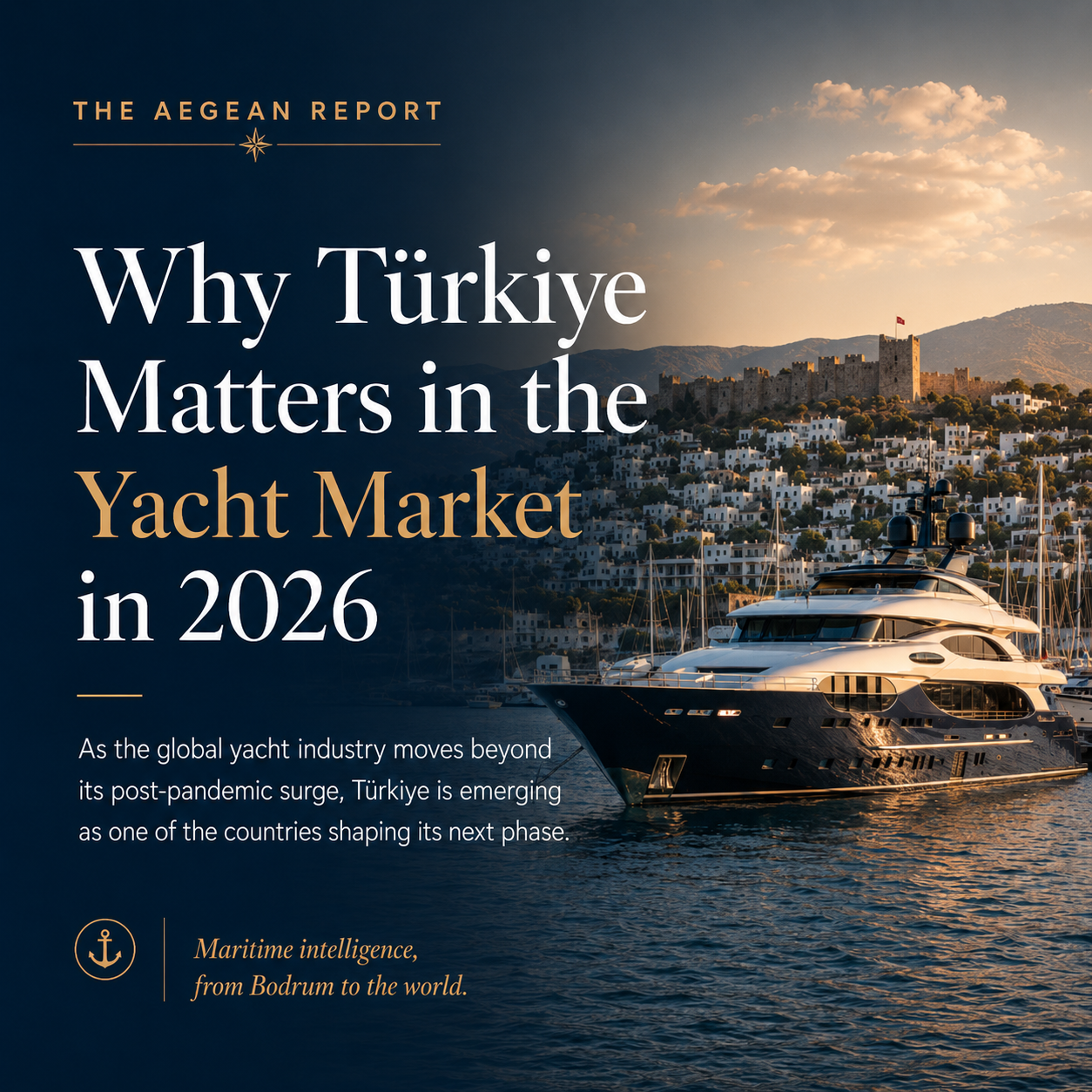
From Bodrum, the yacht economy is easy to observe but difficult to define.
It appears in the marinas, where vessels arrive before the summer season begins. It is visible in the shipyards and workshops, where technical expertise meets traditional craftsmanship. It shapes charter routes, tourism businesses and the rhythm of coastal towns. It also raises increasingly urgent questions about sustainability, infrastructure and the future of the Aegean coastline.
For years, conversations about the global yacht market were often dominated by familiar names: Italy, the Netherlands, Germany and the established cruising grounds of the Western Mediterranean.
That picture is changing.
Türkiye has quietly become one of the countries that matter most in the global yacht industry. Its position is no longer based solely on competitive pricing or its appeal as a summer destination. The country is gaining relevance as a yacht-building nation, a charter market and a maritime-services ecosystem.
The shift deserves closer attention.
A market entering a more selective phase
The global yacht market in 2026 is not experiencing a new boom. It is entering a more disciplined period.
The extraordinary demand of the pandemic years has begun to normalize. But normalization should not be confused with collapse.
Türk Loydu’s 2025 Global & Türkiye Yacht Market Report and 2026 Outlook describes the current period as a transition away from volume-driven expansion and toward larger, more complex and higher-value yachts.
A mid-year report published by Türk Loydu in 2025 counted 1,138 superyachts under construction or on order worldwide. Together, these projects represented 45,487 metres in total length and approximately 577,482 gross tonnes.
The numbers point to a market that remains substantial, even as its character changes.
The most important story is not simply that yachts are being built. It is that the centre of gravity is moving upward. Larger vessels, expedition-style yachts and more technically sophisticated projects are becoming increasingly important. Türk Loydu’s 2026 outlook also highlights record performance in the explorer-yacht segment.
This reflects a broader shift in how yachts are imagined and used. For some buyers, a yacht is no longer designed only for a summer itinerary along the Mediterranean coast. It may also be expected to support longer journeys, remote destinations, extended time on board and a greater degree of independence.
The industry is becoming more selective. But it is not becoming less ambitious.
Türkiye rises to second place
Within this changing market, Türkiye has reached a notable position.
According to Türk Loydu’s April 2026 outlook, Türkiye ranks second worldwide with 146 active yacht projects. The same report states that the country’s average yacht length has risen to 43.9 metres, surpassing key competitors.
This is a significant development.
Türkiye is not replacing Italy, the Netherlands or northern European shipbuilding centres. Each market has its own strengths, reputation and client base. But Türkiye is becoming harder to overlook.
Turkish shipyards have developed a strong position in custom and semi-custom construction, particularly in the mid-size and large-yacht segments. Their appeal is not based on a single advantage. It comes from a combination of skilled labour, technical capability, craftsmanship, flexibility and access to a dense network of suppliers and maritime professionals.
The country also benefits from its geography.
Türkiye sits between established European markets and some of the world’s most attractive cruising grounds. Its coastline connects shipyards, marinas, charter businesses, tourism operators and maritime-services companies across several regional clusters, including Istanbul, Yalova, Antalya, Marmaris, Fethiye, Göcek and Bodrum.
This creates an ecosystem rather than a single industry.
A yacht may be constructed in one city, maintained in another and used for charter along a coastline that connects Türkiye with nearby Greek islands and the broader Eastern Mediterranean. The economic impact extends to repair, refit, provisioning, crew services, hospitality and local businesses.
Growth comes with pressure
Türkiye’s rise should not be presented as an uncomplicated success story.
The same conditions that make the country attractive can also create risks. High inflation, currency volatility and rising input costs place pressure on shipyards and suppliers. International contracts require careful cost management, particularly when construction timelines extend over several years.
Competition is also intensifying.
Türkiye must continue to invest in quality standards, technical expertise, project management, sustainability credentials and after-sales services. Competitive pricing may attract attention, but reputation is built through consistent delivery.
The environmental question is equally important.
The yacht economy depends on the beauty and accessibility of the coast. Yet increasing maritime traffic, marina demand and tourism pressure can threaten the same coastline that gives the industry its value.
The future of the sector cannot be measured only by the number or size of yachts under construction. It must also be measured by the quality of marina infrastructure, waste-management systems, shore-power capacity, coastal protection and the ability of local communities to benefit without being overwhelmed.
Where Bodrum fits into the story
Bodrum is not Türkiye’s largest yacht-construction centre. Its role is different.
Its value lies in the way several parts of the maritime economy meet in one place: charter, marinas, maintenance, refit, tourism, hospitality, traditional gulet culture and an internationally recognizable coastal identity.
This makes Bodrum an important lens through which to view the wider market.
For visiting yachts, Bodrum can act as a gateway to the Turkish and Greek Aegean. For charter operators, it offers access to routes connecting nearby bays, islands and coastal towns. For maritime businesses, it creates opportunities extending beyond the peak summer months, particularly in maintenance, refit and wintering services.
For the city itself, the question is not whether it should attract more yachts at any cost.
The more meaningful question is how Bodrum can become a higher-quality maritime hub while protecting the coastline, local character and cultural identity that make it distinctive.
There is still a need for better local data. Publicly available statistics do not always provide a detailed picture of yacht arrivals, vessel sizes, marina occupancy, guest spending or the economic effects of the sector at the Bodrum level.
That gap matters.
It creates an opportunity for more reporting, more interviews and a deeper conversation involving marina operators, charter companies, shipyards, local authorities and environmental organizations.
From Bodrum to the world
The yacht market in 2026 is not defined by a single headline.
It is not simply booming, and it is not in decline. It is becoming more mature, more complex and more demanding.
Türkiye’s rise reflects that transition. The country has moved beyond the role of an emerging alternative and into the ranks of the industry’s most relevant players. Its next challenge will be to turn growth into a durable reputation.
Bodrum has a role to play in that story.
Its future will not depend solely on the yachts that arrive in its marinas. It will depend on whether the city can connect maritime business with a broader vision for the Aegean: one that values expertise, culture, sustainability and a stronger relationship with the sea.
That is where the next chapter begins.
#Türkiye#Yachting#Bodrum#Aegean#Superyachts
Comments
Sign in to join the conversation.
No comments yet. Be the first.